Why HB 395 systems aren't eligible for net metering
Rooftop solar customers earn bill credits for every kilowatt-hour they export to the grid. HB 395 plug-in customers don't — and understanding why explains how to actually save money with a small system.
Two different solar worlds
Virginia has two distinct solar programs, and they don't overlap:
Net-metered rooftop solar (Va. Code § 56-594): requires interconnection agreement, bidirectional meter, and system size roughly matched to annual usage. Every exported kWh earns a full retail credit.
HB 395 plug-in solar: no interconnection, no agreement, no export credit. What you produce, you consume in real time. What you don't consume goes to the grid — for free.
What "behind the meter" means
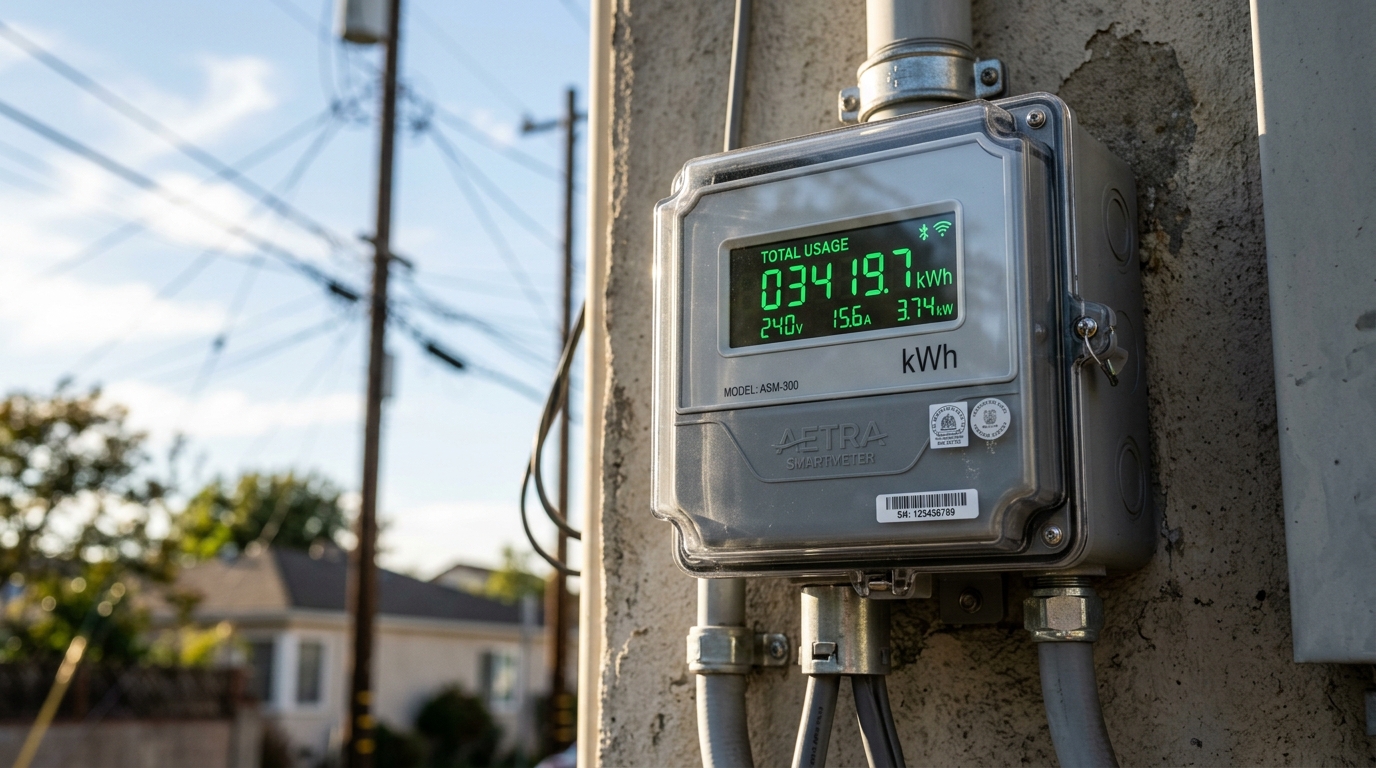
Electricity utilities measure at a single point: the meter on your service entrance. Anything happening on your side of the meter — including a small solar panel plugged into an outlet — reduces the power flowing through the meter but is otherwise invisible to the utility.
That's what "behind the meter" means. The utility doesn't see your panel; it only sees a slightly smaller total consumption. Your savings are the difference between what you would have bought and what the meter actually recorded.
Why the line was drawn there
Net metering carries real administrative costs — engineering review, bidirectional meters, monthly true-up calculations. Those costs are proportional to program complexity, not system size. Applying them to a 400 W panel would consume more utility resources than the panel generates in a decade.
The trade the HB 395 drafters made explicit: skip the paperwork entirely, but skip the export credit too. On systems this small, that trade favors the customer — a rooftop-style interconnection would easily cost $500–$1,500 in fees alone.
"A meter reversal-prevention design combined with a <1,200 W cap creates negligible grid impact and eliminates the need for traditional interconnection review.
"
How to save money anyway
Because you're only credited for self-consumed power, the game is to line up production and consumption. Practical moves:
- Run the dishwasher and laundry midday, not overnight.
- Set electric water heaters to reheat on a midday timer.
- Charge your EV, e-bike, laptop, and power tools during solar hours.
- Precool your apartment before peak evening rates kick in (Time-of-Use plans only).
A household that shifts even 40% of discretionary load into daytime hours will roughly double the effective value of a plug-in system.
If policy changes later
The SCC's HB 395 implementation order leaves the door open to a future "small-generator credit" — a simplified export credit specifically for plug-in systems. Utah is piloting one now. Watch news & updates for movement on Virginia's version, likely no earlier than 2028.
Related Reading
- Compare economic returns between system types in our plug-in vs rooftop solar financial math.
- Calculate annual kWh savings in our guide to estimating annual electricity cost savings.
- Review utility notice requirements in our overview of Dominion Energy notification policies.
Stay updated on Virginia balcony solar
Get notified when the State Corporation Commission issues new HB 395 regulations, forms, or legal updates.
Was this article helpful?
Your feedback helps us keep this guide accurate and easy to use.